High-Stakes Generality · Navier-Stokes C1 · 2026-05-31
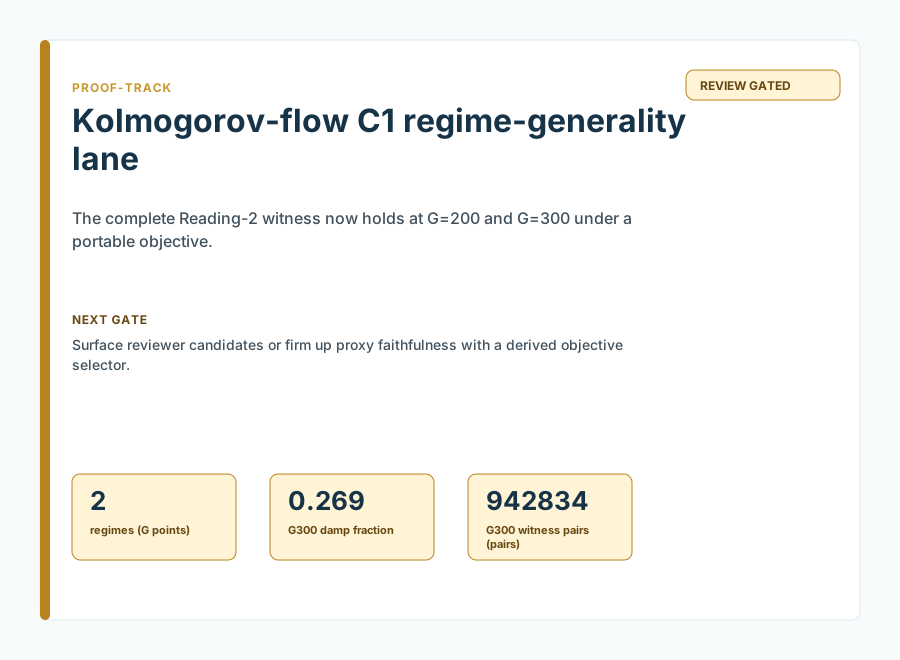
A regime-2 witness now holds at two Grashof points.
The Coarse-Graining Postulate 1 reading of a Kolmogorov-flow C1
cell produces a Reading-2 regime-2 witness
— state-insufficient AND control-sufficient — that now
replicates at a second Grashof regime under a portable
objective. It holds at (k_f = 2, G = 200) and
(k_f = 2, G = 300); the control half is
dimension-robust (d = 32 and d = 18) and objective-robust
(fixed-percentile and portable-quantile), composed at matching
ε_K = 0.0664. This is a witness,
not a Navier-Stokes existence or smoothness claim, and not a
Clay-problem-adjacent claim.
The Load-Bearing Statement
Two-regime, dimension- and objective-robust, end-to-end Reading-2 witness.
The phrasing matters. This is not a Navier-Stokes existence/smoothness claim, not a Clay-problem-adjacent claim, and not a claim that Sundog has produced original PDE mathematics. Any public copy that elevates this witness into a theorem-facing posture silently retires the discipline that makes the result interesting.
(k_f = 2, G = 200) and
(k_f = 2, G = 300); the control half is
dimension-robust (d = 32 and d = 18) and objective-robust
(fixed-percentile and portable-quantile), composed at matching
ε_K. The Postulate-1 reading is non-vacuous on a
real substrate. C1 remains UNPROMOTED.
In Plain Words
The body roams; its shadow still decides.
Picture the flow as a body — the full swirling fluid, hundreds of numbers — and a shadow: just its largest-scale features (the "signature"). Sundog's house question, the same one the solar-halo front page opens with and the h-of-x equation makes literal, is whether that shadow carries enough structure to act from when the body is too large to read directly.
Here the answer splits, and the split is the interesting part. You cannot rebuild the full fluid from the shadow — genuinely different bodies cast the same shadow, and we certify it with hundreds of thousands of matched "twin states." But you can make the one safety decision the controller cares about — is a low-band energy spike coming? — from the shadow alone, and get it right almost everywhere. State-insufficient, yet control-sufficient. It is like reading the time off a shadow without being able to rebuild the clock.
New here? That two-part move — read the shadow, then name exactly where it breaks — is the whole site in miniature; the generality umbrella runs it across six harder substrates. Reviewing this? The precise statement, the clause-by-clause claim ledger, and the glossary to standard observer-theory language are in the Proposition.
What The Witness Is
Reading 2 = state-insufficient AND control-sufficient at a matched signature radius.
Reading 2 is the regime where the standard determining-modes signal
fails to reconstruct full state, but a smaller Postulate-1 signature
nevertheless suffices for the control objective. The witness is
constructive: pairs of trajectories that agree on the signature to
within ε_K = 0.0664 also agree on the proxy-action
objective, at a level that no random-label control reaches.
The G=200 read used the fixed-percentile objective at
d = 32, with witness slope 0.736 and
a_mm = -0.00079. The G=300 read used the portable
quantile objective at d = 18, with
a_mm = +0.00058 through the origin and a damp fraction
of 0.2688 — well above the v6
0.004 vacuity that motivated the regime-generality
pivot. The portable objective is a new objective, so the
v5 witness had to be re-established under it before the G=300 test
could be admitted; that re-establishment held, with G=200 numbers
near-identical to the v5 old-objective read.
The G=300 twin-state lock is certified: TWIN_STATE_CERTIFIED,
100% witness coverage, 942,834 unique pairs, with δ_H = 0.0111
against a real median ‖Q_K‖ = 0.222. The cell-set spec,
integrator energy-conservation self-test, and pre-registered
verdict-rule completeness all closed cleanly before the verdict
was interpreted.
The Mechanism, Measured · Named Novelty: MZ
Why the shadow can decide — a Mori–Zwanzig energy budget that closes on the signature.
A witness that something works is stronger once you can say why. The why here is an energy-budget reading, and it is where we name the explicit novelty.
Split the low band's energy tendency into a part fixed by the
signature and a leftover coupling to the unresolved high
modes: dE_low/dt = g(Φ_K) + R. A short
lemma we can prove says the band cannot feed
its own energy — the signature-only transfer
T_LLL ≡ 0 — so R is the
entire inter-scale transfer, all of it high-mode
mediated. The naïve hope, "R is small," is
therefore false by conservation.
The measured fact is subtler and stronger: R is
~99% a function of the signature
(held-out R²(R | Φ_K) = 0.998 at G=200 and
0.990 at G=300, with calibrated positive and
negative controls) — even though the high-mode state is
certified not reconstructable from the signature. The
flow's state roams; its decision-relevant energy budget is
slaved to the shadow.
Citation Spine
The MZ name is not a novelty grab. It points to the standard projection / memory formalism; the Sundog-specific claim is the measured decision-observability split where state reconstruction fails.
This is explanatory, not promotion-bearing: it grounds the existing numbers, it does not move C1's status. Detail in the MZ energy-budget diagnostic, framed against standard observer theory in the separation statement (§7).
The Honest Limitation
Marginal, not sharp — and the page says so first.
The separation is real and certified but
physically marginal. The signature
reconstructs the energy-carrying content of the state almost
completely — fraction of variance explained
0.997 in the energy norm and 0.993
in enstrophy — so K = 3 sits near the
determining-modes threshold, and the genuinely
under-determined part is dynamically-negligible
dissipation-range noise. 2D Kolmogorov flow at moderate
Grashof has a low-dimensional attractor; the body barely
resists its shadow.
We tested the cheap escape — re-reading the gap in the enstrophy norm at G=200 — and it failed (still marginal). A genuinely non-marginal separation, where physically-relevant content is under-determined, needs a higher-dimensional regime (much higher Grashof, 3D, or a different substrate), and that route hits the same numerical wall as the Sabra-shell C2 lane — it needs an adaptive integrator. Stated plainly so a reviewer never has to extract it: this is a weak instance of the regime-2 target, not a gross state/control gap.
Adversarial Robustness · 2026-05-31 · we tried to demote it
Is the shadow only deciding because it nearly rebuilds the body? We pre-registered a probe to find out — and it survived.
The honest limitation above invites the sharpest objection a reviewer can raise: if the signature reconstructs ~99% of the energy-carrying state, then "control-sufficient" might just be "near-determining" wearing a different hat — the shadow decides only because it almost is the body. So we pre-registered a probe designed to demote our own result, with the verdict fixed both ways before it ran.
The test: does control-sufficiency simply track how
predictable an objective is from the signature, across a slate
of six objectives spanning the resolved band down into the
dissipation range? If it did, the separation would be a
closed-subspace artifact. It does not. The
signature predicts every objective well —
fraction-of-variance 0.76 to 1.00,
including the high band and the dissipation range — yet
control-sufficiency does not track that
predictability (rank correlation −0.75 and
−1.0, the opposite of the demotion
hypothesis). The decision-observability split is not the
near-determination in disguise.
And the page flags the one loose thread first.
The slate also surfaced an unexpected, still-open puzzle: a
dissipation-weighted objective (palinstrophy) the
signature predicts perfectly yet is not
control-sufficient for — predictable but not
controllable, the reverse of the usual story. We do not yet
know whether that is a real phenomenon or a burst artifact; it
is logged as an open thread, not smoothed over. This is
robustness, not promotion: it strengthens the
framing for review; it does not move C1's status.
Detail in the objective-overlap discriminator (pre-registration + result §12).
Hypothesis · tested · falsified · re-aimed
We took the split to a resistant body. It wasn't resistant. So we build one that is.
The hypothesis was falsifiable, so we falsified it.
The separation measured here is marginal only because
the 2D-fluid attractor is low-dimensional — the signature
nearly reconstructs the whole state, so there is little
"state" for the decision to be unobservable from. The
test was to carry the same reconstruction measure (does the
low-dimensional shadow rebuild the full state?) to a
substrate whose body genuinely resists its shadow. The
candidate was Mesa's entangled,
decomposition-resistant 5-dimensional net.7
subspace.
It came back marginal too. Ported directly,
the measure showed the 256-wide net.7 is
effectively ~2-dimensional — it is a function of a
six-number observation — so the 5D shadow reconstructs ~99% of
it. Mesa is sharp on a different axis (its subspace
resists being decomposed into simpler features), but on the
state-reconstruction axis this split actually needs, it is
marginal, like the fluid. The strongest dynamical-system
candidate — a Sabra shell model with a small-scale objective —
came back the same. Three for three.
The reason is structural, and it says where to build.
A sharp split needs a body that genuinely resists
reconstruction from its shadow — not a turbulent cascade
that concentrates its content in a few slaved modes, and not a
controller whose state, however wide, is effectively a function
of six numbers. Raw dimension is not the axis: the 256-wide
net.7 is effectively ~2-dimensional and is rebuilt
~99% by its shadow, and it came back marginal anyway. That points
away from physics substrates and toward a control system whose
state is not recoverable from a compact shadow. So
the next build heads to a language-model substrate
— the chat lane — where the body (the model's
internal state across a conversation) is the candidate
resistant body and the shadow (a maintained ledger) is where we
ask whether the same decision-observable-but-state-unobservable
split finally turns sharp. This is the measured reason
for the pivot, not a result on the model; a first round
of that test has now been scoped and run: at low dimension the
answer is positive and machine-anchored — a pretrained model
demonstrably carries an order-dependent state that no count
statistic can recover (the impossibility a machine-checked
theorem, the carry a measured crossover) — while at bank scale
every natural-data construction failed a pre-registered,
matched-baseline gate across six label families and two model
scales, so the substrate claim stays with the toy result at its
licensed scope, and
the ∞-dimensional NSE-attractor analogue likewise remains
separately hypothesized, cited but not applied.
Falsification Surface
Five named failure modes — what would falsify the coupling claim.
The coupling between Sundog's Postulate-1 discipline and the open Navier-Stokes front is staged on two fronts (a defensible reading leg and a horizon empirical leg) and can fail in five named modes. Each candidate work item declares which modes it attacks.
1 Front-A vacuity
The Postulate-1 reading of determining modes, once written, reduces to what any careful PDE analyst would already say. The instrument has no edge over a good review.
2 Front-A miscalibration
The Postulate-1 / Blackwell-sufficiency distinction lands on confidently wrong readings — claims a control-sufficient signature where determining-modes literature already pins state-reconstruction sufficiency at a smaller mode count that suffices for control too.
3 Front-B vacuity
On shell models, a matched-budget DMD / critical-slowing-down / lacunarity / Rényi baseline detects intermittent bursts at least as well as a signature-based detector. Signatures add no signal.
4 Front-B reach
Even a clean shell-model positive silently smuggles in finite-dimensional truncation structure that does not survive the move to full 2D-perturbed or 3D small-data NSE. Cross-substrate sameness fails at the substrate boundary.
5 Coupling overreach
The ledger is published alongside a public workbench, reading, or claim that elevates a Front-A reading or Front-B shell-model result into a Clay-problem-adjacent posture. Detected by the Claims & Scope audit on any deploy that touches NSE vocabulary.
Next Gate
External PDE reviewer + derived objective selector.
Promotion criteria for the Navier-Stokes ledger require all four of: (a) Front-A vacuity rebutted; (b) runnable Phase-0 deliverable with pre-registered cell set and matched-seed baselines; (c) external-mathematician sanity-check path named; (d) pre-registered failure boundary fixed before numerical reads are interpreted.
The current witness materially advances (a) — a concrete regime-2 witness shows the Postulate-1 reading is non-vacuous on a real substrate — and closes (b) at the procedure-and-execution level. (d) is closed by construction (the cell set, integrator self-test, and verdict-rule completeness are all locked before interpretation). (c) is open and review-gated: an external PDE reviewer pass on Front-A is the next promotion step. The reviewer-facing packet now arrives with the most likely objection — whether the split is merely near-determination — already tested in the open (see Adversarial Robustness, above), so the ask is a focused sanity check, not an open investigation. Final (d) close is coupled to (c). The full twin-state lock receipt and proxy-faithfulness items remain open as part of (c).
Until (c) closes, this page carries the review-gated badge prominently and does not collapse the witness into a positive theorem-facing claim.
Claim Boundary
Sundog has not solved Navier-Stokes.
This page describes a witness on a Kolmogorov-flow cell at two Grashof points. It is finite-Galerkin, sampled-support, numerical. It is not an infinite-dim NSE theorem.
Signatures do not replace energy methods.
The Postulate-1 reading is a reading and instrument complement to existing determining-modes machinery, not a replacement for energy-side analysis.
Coarse-graining does not prove regularity.
The coarse-graining proof trunk (Phases 0-3 closed positive; Phase 4 open at the Bayesian-floor gate) is a separate theorem-facing program. It does not, on its own, prove NSE regularity. The witness here couples to it; it does not extend it to NSE smoothness.
Determining modes are not Sundog's idea.
Foias-Temam-Constantin determining modes / nodes / volumes are the prior-art spine. The Sundog contribution is a Blackwell-sufficiency reading of the same object, not a new PDE result.
Inspection Trail